
ADEKA and Honjo Chemical Successfully Demonstrate Drone Flight Using Next-Generation Lithium-Sulfur Rechargeable Battery
Apr. 24, 2026
ADEKA CORPORATION and Honjo Chemical Corporation have conducted a successful flight demonstration of a small drone powered by a prototype next-generation lithium-sulfur rechargeable battery (Li-SPAN battery) developed using materials from both companies. The drone achieved a continuous flight time of 19 minutes and 48 seconds, approximately twice that of a comparable commercially available battery of the same weight.
The Li-SPAN battery combines lightweight with rapid discharge capability, addressing one of the long-standing challenges of lithium-sulfur batteries--insufficient power output. This achievement represents a significant step toward the social implementation of high-power, lightweight lithium-sulfur batteries for drones and other flying-vehicle applications.
In parallel with the flight demonstration, ADEKA is conducting charge-discharge cycle testing tailored for use in flying vehicles. The prototype has successfully achieved 10 cycles to date, with further testing ongoing. In addition, the excellent ignition safety performance of various Li-SPAN battery cells have been previously reported in joint publications with partners including General Motors Company and the National Institute of Advanced Industrial Science and Technology (AIST).
ADEKA remains committed to accelerating the commercialization of lightweight, high-power, and safe next-generation rechargeable batteries by developing SPAN materials. To this end, we will continue to promote collaboration and partnerships with companies, research institutions, and universities.
Test flight footage of a small drone equipped with a prototype Li?SPAN battery.
Demonstration Overview
Li-SPAN Battery Prototype
Specifications |
Li-SPAN battery (6S1P pack, 2 Ah, 10 V)
|
|---|---|
Main materials |
Cathode active material: ADEKA-developed sulfur-based cathode material SPAN(ADEKA AMERANSA® SAM-101)
|
Battery design / Assembly |
Battery design: ADEKA, Partner companies
|
Drone Flight Test
Platform |
Industrial micro drone for aerial imaging (wheelbase 95 mm, approx. 100 g) |
|---|---|
Environment |
Indoor, windless, room-temperature conditions |
Flight time |
・Li-SPAN battery: 19 min 48 sec
|
Charge/discharge cycle test |
10 cycles have been recorded at 0.3C / 0.3C.
|
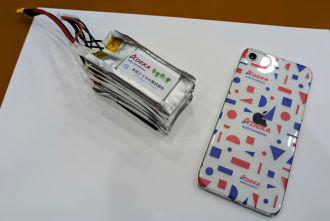
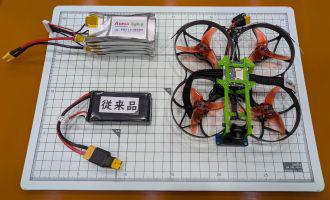
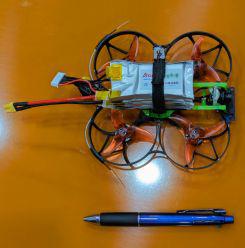
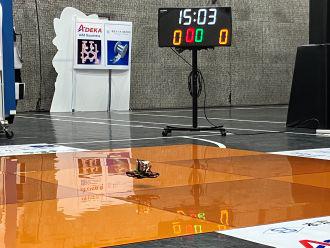
(Top left) Li-SPAN battery
(Top right) Li-SPAN battery (92 g), commercial battery (92 g), and drone
(Bottom left) Drone equipped with a Li-SPAN battery
(Bottom right) Drone flight demonstration

Reference: Peer-reviewed publications on SPAN.
-
"In collaboration with Gunma University"
- Ultra-lightweight rechargeable battery with enhanced gravimetric energy densities >750 Wh/kg−1 in lithium-sulfur pouch cell: Communications Engineering, 3, 177 (2024) "In collaboration with URUTAMA Inc., SoftBank Corp., KISCO LTD., National Institute of Advanced Industrial Science and Technology (AIST), and ATTACCATO LLC"
- Lithium-Sulfur Rechargeable Battery Cells with SPAN/Resin Film Cathodes for Lightweight and Safety: Electrochemistry, 93, 063023 (2025) "In collaboration with Osaka Metropolitan University"
- Understanding capacity degradation in sulfurized polyacrylonitrile (SPAN) electrodes insights from transmission electron microscopy: Journal of the Ceramic Society of Japan, 133, 765 (2025)